
A shiny is a rare version of a fusion you already know: the same two parents and the same hybrid name, with a Golden, Diamond, Iridescent or Chaos label above the stars. The pop-up prints the odds for that exact result, and recorded readings run from 1 in 7 for a 13-star Golden to 1 in 221 for a 21-star Chaos. The label adds +2, +4, +6 or +10 stars.
What the Shiny Label Changes
A shiny is not a separate animal. The parents are the same, the hybrid name is the same, and the label is the only difference on the card: Foxant (Golden) against a plain Foxant. Two things on the card move with the label:
- The tag above the star row reads Golden Shiny, Diamond Shiny, Iridescent Shiny or Chaos Shiny.
- The star count comes out higher than the standard result of the same pair. The panel prints one bonus per label; the section below lists the numbers.
The $/s figure on the same screen decides what the roll was worth, and it does not follow the label. That is the next section but one.

The Odds Line on the Pop-Up
Each shiny pop-up carries an Odds line. Seventeen readings came off nine recordings, and they do not line up with the colour alone:
| Result | Parents | Stars | Odds printed |
|---|---|---|---|
| Solareclava (Golden) | Solar Eclipse + Lava | 13★ | 1 in 7 |
| Solareclava (Diamond) | Solar Eclipse + Lava | 15★ | 1 in 16 |
| Puffertle (Diamond) | Pufferfish + Turtle | 20★ | 1 in 39 |
| Cheeseclipse (Golden) | Cheeseburger + Solar Eclipse | 20★ | 1 in 14 |
| Foxant (Golden) | Ant + Fox | 6★ | 1 in 21 |
| Foxtrex (Diamond) | Fox + T-Rex | 8★ | 1 in 53 |
| Crabfox (Diamond) | Fox + Crab | 11★ | 1 in 137 |
| Axolocrab (Iridescent) | Crab + Axolotl | 10★ | 1 in 212 |
| Ankylosauruby (Iridescent) | Ruby + Ankylosaurus | 11★ | 1 in 21 |
| Zebruby (Chaos) | Ruby + Zebra | 21★ | 1 in 221 |
| Cheeseburus (Golden) | Mosasaurus + Cheeseburger | 5★ | 1 in 2 |
| Dolphasaurus (Diamond) | Mosasaurus + Dolphin | 8★ | 1 in 5 |
| Mosasarthog (Golden) | Mosasaurus + Warthog | 9★ | 1 in 5 |
| Turus (Iridescent) | Mosasaurus + Turtle | 9★ | 1 in 15 |
| Mosasaurilla (Iridescent) | Mosasaurus + Gorilla | 10★ | 1 in 21 |
| Carringmantis (Iridescent) | Carrot + Praying Mantis | 9★ | 1 in 15 |
| Cheeseclipse (Diamond) | Cheeseburger + Solar Eclipse | 22★ | 1 in 36 |
Six of those rows carry the same Diamond label and print different odds. One 8-star result printed 1 in 53 and another printed 1 in 5; the 11-star printed 1 in 137; the 15-star printed 1 in 16; the 20-star printed 1 in 39, and the 22-star printed 1 in 36. So the number on the pop-up describes the result in front of you, not a flat Diamond rate you can plan around, and a higher star count did not mean a rarer roll: the two 8-star readings sit at both ends of the range, and the 20-star printed worse odds than the 15-star.
The colour is not a flat rate either. A 20-star Golden Cheeseclipse printed 1 in 14 in one recording, while a 20-star Diamond Puffertle printed 1 in 39. Same star count, different label, odds 2.8× apart, so read the line on your own pop-up rather than assuming the higher tier is the rarer roll.
The two Solareclava rows come from one pair, Solar Eclipse + Lava, fused minutes apart. That pair is worth reading as a set because everything else on the card moved with the label too: the plain result printed 11 stars and $922/s, the Golden printed 13 stars and $247K/s, and the Diamond printed 15 stars and $13.21K/s. The star step matched the tier panel exactly (+2 and +4). The $/s number moved in both directions, so it is not a fixed function of the label — read it off your own result before you decide whether a roll was worth the parents.





The Chaos row is the widest odds line recorded so far: 1 in 221 for a 21-star roll. The same pair, Ruby + Zebra, printed a standard 11-star result at $920/s in the same recording, and the Chaos card printed $1.02M/s — a 10-star jump that matches the bonus the tier panel prints under the label.
The Friend Bonus the Game States
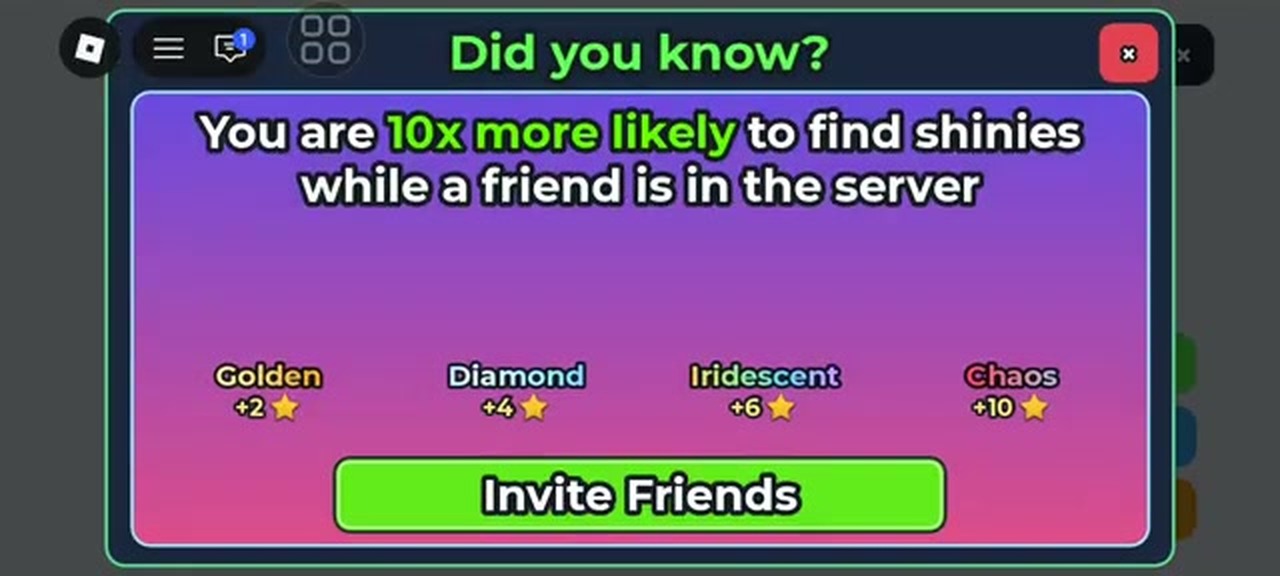
The same panel that lists the tiers carries a line the game states plainly: you are 10x more likely to find shinies while a friend is in the server, with an Invite Friends button underneath. That is the only modifier the game itself prints. Two things it does not say: whether each extra friend multiplies again, and whether the boost applies to Double Fusion as well as to standard fusion. No recording here separates those cases, so neither claim is made.
What Each Label Adds to the Stars
| Label | Stars added |
|---|---|
| Golden | +2★ |
| Diamond | +4★ |
| Iridescent | +6★ |
| Chaos | +10★ |
Those four numbers come from the same panel, and two unrelated recordings print them identically. One was uploaded on 11 October and one on 15 October, from different channels, so the panel is not a one-off screen.
Correction. Earlier pages on this site printed +8★ for Chaos. Both frames now read +10★, and the +8 reading does not reproduce in either recording. The table above carries the corrected value.
A bigger bonus is not automatically the better hybrid. The label raises the star count; the $/s rate on the result screen is what the pen earns. Recorded Diamond 7-star results came out at $25/s and $38/s, against a $27/s to $42/s band for standard 7-star results — one below that band and one inside it, so the label alone did not set the income.
How a Shiny Reaches an Egg
Eggs carry the tags too. A Wild reward pad printed Common Egg (Golden) — 6★ when hatched, and the hatch card repeated the promise with the hybrid name and its two parents.
Run the panel's arithmetic against the egg bands this site has recorded, and both samples close:
- Golden. A Common Egg prints 3★–5★, and Golden adds +2★, so the egg should land at 5★–7★. The recorded pad printed 6★, inside that range.
- Chaos. The same Common Egg plus +10★ gives 13★–15★, which is exactly the band a recorded chaos egg printed.
That fit is arithmetic on printed numbers, not a rule the game states, and two samples do not prove it for every egg. What it does settle is the earlier confusion: with the corrected +10★, the chaos egg is no longer an exception. Read the tag on the pad, add the bonus, and compare the total with the band under when hatched.

Only a Golden and a Chaos egg screen have been recorded here. Whether Diamond and Iridescent tags appear on eggs, and at what bands, is not known.
Two Ways to Roll One
Both fusion routes can produce a shiny, and neither offers a guaranteed result.
- Standard fusion. Pick two unlocked animals, run the fusion, and read the label above the stars. If the result is standard and you want another attempt, press NEW FUSION rather than SAVE HYBRID — the pair is re-rolled. The steps and the save decision are on How to Fuse a Hybrid.
- Double Fusion. Two saved hybrids and one Fusion Token. Recorded Double Fusion results include a Golden 10★, an Iridescent 12★, a Diamond 26★ and Chaos results at 30★ and 35★, so the route reaches the highest tiers. The token price, the input check and the pitfalls are on Double Fusion & Variants.
What decides the star count is not recorded. The same two parents produced a 6★ standard Dragowl on one attempt and an 8★ Golden Dragowl on another, so the roll decides, not the parents' strength.
What a Shiny Does Not Change
- Training does not raise the card numbers. A recorded Venusflylytrex (Golden) showed 10★ and $429/s at Lv. 1, and the same 10★ and $429/s at Lv. 506. Levels are for The Wild.
- The label does not set the income. Compare the $/s on your result screen with the standard result for the same pair, not with the colour of the tag.
- A shiny still takes one pen slot. An incubating egg holds a slot without earning; a saved hybrid earns its own rate.
Which Shiny to Keep
The cleanest recorded comparison is one pair, fused twice. Owl + Dragonfly produced a standard 6★, $16/s Dragowl and a Golden 8★, $73/s Dragowl — two more stars and roughly four and a half times the income.
Use that shape as your test. Read the $/s on the result screen, compare it with the standard result for the same parents in the recorded recipe list, and ask whether the difference pays for the pen slot it occupies. If the pen is full, the comparison is against whatever the weakest hybrid in it already earns, which is the same arithmetic as choosing what to replace.
One warning that costs more than a bad roll: do not fuse away the hybrid you trained for The Wild. A shiny result is not worth a fighter you spent hours levelling.
What Is Still Not Recorded
- Whether the printed odds are per roll or per star count. Four Diamond readings printed four different numbers, and the odds did not follow the star count: 15 stars gave 1 in 16 and 20 stars gave 1 in 39. Nothing found so far says which variable moved, and the Chaos row (21 stars, 1 in 221) does not settle it either.
- Whether the friend bonus stacks, or applies to Double Fusion.
- Diamond and Iridescent egg tags.
- Whether the odds changed across the October updates. The readings here come from recordings dated 11, 15, 25, 26 and 29 October 2026.